

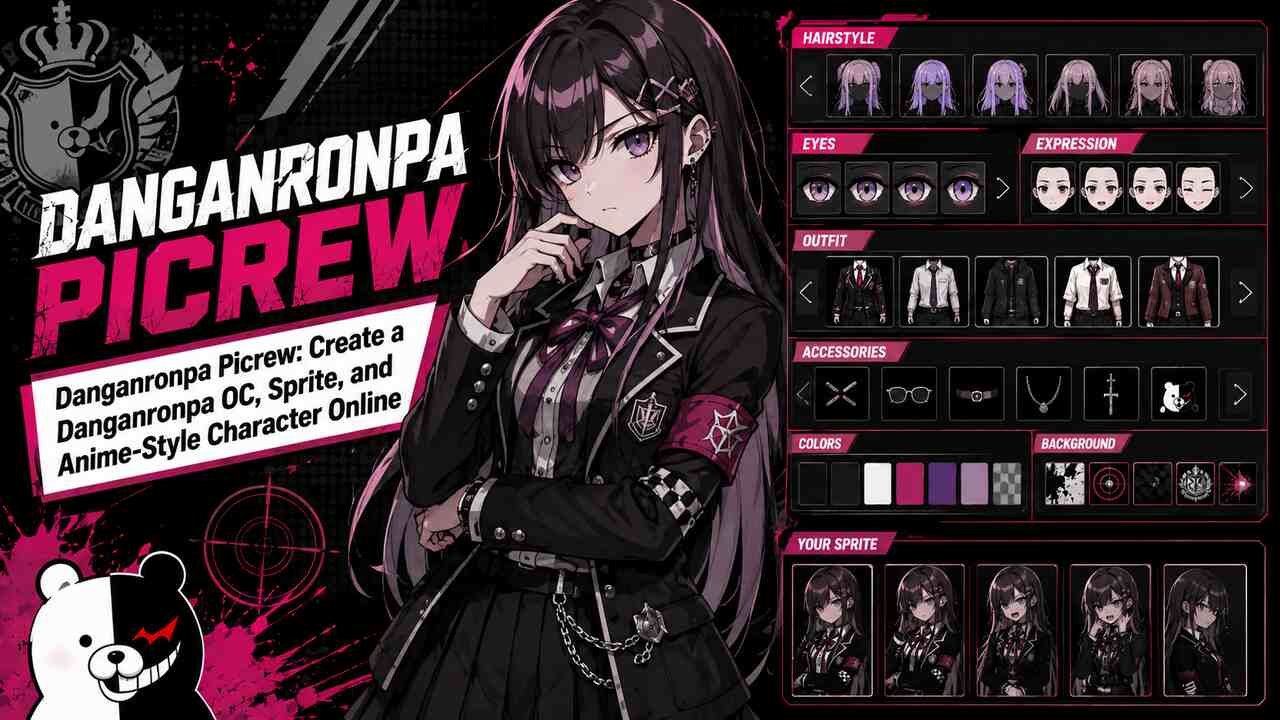

A Danganronpa Picrew lets fans build an original character with the dramatic hairstyles, expressive faces, uniforms, accessories, and anime-inspired visual features associated with Danganronpa-style character design. Instead of drawing every element manually, users can select premade visual parts created by a Picrew artist and combine them into a personalized avatar or original character, commonly called an OC.
Several Danganronpa-inspired character makers are currently available on Picrew, including Rippilie’s Danganronpa Maker, Danganronpa OC Maker, danganronpa style oc maker, and a Danganronpa sprite maker. Availability can change because individual creators control their image makers and may update, restrict, or remove them.
The best results come from treating a Danganronpa Picrew as more than a random avatar generator. A memorable character needs a recognizable silhouette, coordinated colors, expressive facial features, a believable talent or role, and visual details that support the character’s personality. This guide explains how to find a suitable maker, create a distinctive Danganronpa OC, develop a coherent design, save the finished image correctly, and understand Picrew’s usage permissions before sharing it.
Choose a Danganronpa Picrew Maker That Fits Your Character
Start by selecting a Picrew maker that supports the kind of character you want to create. Different Danganronpa-inspired makers emphasize different visual features, so a maker that works well for a school-uniform character may not be ideal for a dramatic sprite or highly customized OC.
Current search results on Picrew include multiple relevant options. Rippilie’s Danganronpa Maker describes itself as an OC maker that allows users to create characters, while another Danganronpa OC Maker says it was created by an artist who previously made Danganronpa OCs and commissions. Picrew also hosts a danganronpa style oc maker and a separate Danganronpa sprite maker.
Compare the available parts before committing to one maker. Check whether it offers the hairstyle, skin tone, eye design, clothing, accessories, facial expressions, and background options you need. Some makers provide broad customization, while others are intentionally designed around a narrower visual style.
| Danganronpa Picrew option | Best suited for | Main design goal |
|---|---|---|
| Rippilie’s Danganronpa Maker | General OC creation | Building a recognizable Danganronpa-inspired character |
| Danganronpa OC Maker | Original students and fan characters | Combining custom appearance choices |
| danganronpa style oc maker | Modern Danganronpa-style portraits | Creating an anime OC with franchise-inspired styling |
| Danganronpa sprite maker | Sprite-focused characters | Producing a character that resembles a game-style portrait or sprite |
Picrew makers are created independently, so the number of parts and available combinations can differ considerably. A useful approach is to test two or three makers before finalizing your character. Recreating the same basic OC in several makers can also reveal which art style best communicates the personality you have in mind.
Decide Your Danganronpa OC Concept Before Selecting Parts
Create a short character concept before choosing hairstyles and accessories. The concept does not need to be complicated. A name, personality trait, talent, and dominant color are enough to guide most visual decisions.
Danganronpa fan characters are frequently designed around an “Ultimate” talent or another distinctive skill. You might create an Ultimate Botanist, Ultimate Magician, Ultimate Investigative Journalist, Ultimate Violinist, Ultimate Meteorologist, or Ultimate Game Designer. The talent gives you a practical framework for selecting clothing and accessories.
For example, an Ultimate Botanist could use green accents, a flower accessory, natural colors, and a calm expression. An Ultimate Stage Magician might use darker colors, formal clothing, dramatic eyes, gloves, or theatrical accessories. An Ultimate Programmer could have a simpler uniform paired with headphones, glasses, or technology-inspired details if those items are available.
Your OC should also have a dominant personality signal. A cheerful character might use brighter eyes, an open smile, and warm colors. A reserved character might use a neutral expression, muted colors, and carefully arranged hair. An intimidating character can use sharper eyes, stronger contrast, and a more controlled expression.
Planning these details first prevents a common problem in character makers: choosing attractive individual pieces that do not work together as a complete design.
Build a Recognizable Face Before Adding Decorative Details
Begin the actual Danganronpa Picrew character by establishing the face. Choose the skin tone, eyes, eyebrows, mouth, and other facial elements before moving into accessories. These features communicate personality more strongly than most decorative additions.
Pay particular attention to the eyes. Anime character makers commonly use eyes as one of the primary emotional signals. Larger or more open eyes can suggest enthusiasm, curiosity, or innocence, while narrower eyes may create a serious, confident, mysterious, or skeptical impression. Eyebrow angle further changes the emotional reading of the same eyes.
The mouth should reinforce the expression rather than contradict it accidentally. A small smile can make a neutral character approachable. A wide grin can suggest confidence or energetic behavior. A flat or slightly downward mouth can indicate seriousness, fatigue, suspicion, or emotional distance.
Combine these elements deliberately. If the character is supposed to be an anxious student, for example, alert eyes, raised eyebrows, and an uncertain mouth create a more coherent result than mixing an aggressive expression with unrelated cheerful features.
Small facial details can then add individuality. Depending on the maker, these may include freckles, blush, scars, facial markings, glasses, piercings, or other features. Use them selectively so the character remains readable rather than visually crowded.
Select a Hairstyle That Creates a Distinctive Silhouette
Choose hair based on silhouette as well as color. Strong anime character designs can often be recognized even when facial details are removed because the hairstyle establishes a memorable outer shape.
Start with overall length and volume. Decide whether the OC has short, medium, or long hair and whether the shape should appear neat, messy, spiky, layered, curled, or asymmetrical. Then select bangs and secondary hair components that complement the main shape.
Danganronpa-inspired designs often benefit from one unusual but controlled feature. That might be an exaggerated strand of hair, a contrasting section, a distinctive fringe, unusual volume, or a carefully placed accessory. The goal is not to add every dramatic option available. One memorable feature usually works better than several competing features.
Hair color should also support the overall palette. Natural black, brown, blond, and red tones work well for grounded characters, while blue, purple, pink, green, white, or multicolored hair can strengthen a more stylized concept when the maker supports those choices.
If your character already has complicated clothing and accessories, keep the hair slightly simpler. If the outfit is restrained, the hairstyle can carry more of the visual identity.
Coordinate Colors Around One Dominant Palette
Limit the design to a controlled color palette so the finished Danganronpa Picrew looks intentional. Choose one dominant color, one supporting color, and one or two neutral shades.
A character built around burgundy, black, and cream will usually appear more cohesive than a character using unrelated red, turquoise, orange, purple, green, and yellow elements. High color variety can work for deliberately chaotic characters, but it should still follow a pattern.
The dominant color can communicate personality. Blue frequently creates a calm or analytical visual impression. Red can suggest confidence, aggression, passion, or intensity. Purple can support mysterious or theatrical designs. Green can suit characters connected to nature, medicine, research, or unconventional personalities. White, gray, black, and beige provide useful neutral foundations.
Contrast is equally important. Dark hair against pale clothing creates a different focal hierarchy from light hair against a black uniform. If the character’s face begins disappearing visually, change the surrounding colors so the eyes and expression remain noticeable.
You can also connect the palette to the OC’s talent. An Ultimate Astronomer might use navy, violet, silver, and white. An Ultimate Pastry Chef could use cream, pink, brown, and red. An Ultimate Mechanic might use dark gray, orange, blue, and metallic-looking accents.
Match Clothing to the Character’s Ultimate Talent
Select clothing that tells the viewer something about the character before they read a biography. Uniform-inspired clothing is a natural choice for a Danganronpa OC, but small modifications can make the design feel much more personal.
Begin with the basic outfit structure. A blazer, shirt, jacket, sweater, dress, vest, tie, ribbon, or other school-inspired piece can provide the foundation. Then modify the visual impression through color and accessories.
Talent-related details make the concept easier to understand. An Ultimate Detective may have formal clothing, restrained colors, glasses, or a serious appearance. An Ultimate Musician could use headphones, jewelry, expressive hair, or stage-inspired elements. An Ultimate Athlete may have sportswear details or a more practical hairstyle.
Avoid making the outfit too literal. An Ultimate Painter does not necessarily need every available art-related accessory. One or two signals can establish the concept while leaving room for personality.
Also consider whether the character follows school rules visually. A highly disciplined student might wear a neatly arranged uniform. A rebellious student could have an open jacket, unusual accessories, or less conventional styling. Clothing therefore communicates both role and behavior.
Add Accessories That Support the Character’s Personality
Use accessories as evidence about the character rather than decoration alone. Every visible object should ideally reinforce personality, talent, background, or mood.
Glasses can suggest practicality, scholarship, fashion, or reserve depending on the rest of the design. Hair clips can create a playful or organized appearance. Earrings and piercings may make a character appear more fashionable, rebellious, mature, or unconventional. Hats can establish occupation or style when suitable options exist.
Neck accessories are particularly useful because they occupy an important visual area without overwhelming the face. Ties, ribbons, necklaces, chokers, scarves, and similar options can introduce an accent color or reinforce a character archetype.
Limit accessories when the hairstyle already has high visual complexity. A heavily layered hairstyle combined with multiple clips, glasses, earrings, necklaces, facial markings, and a detailed outfit may become difficult to read.
A useful test is to temporarily remove one accessory. If the character still communicates the intended personality, the accessory may be optional. If removing it weakens a major part of the concept, it is probably serving a meaningful design function.
Create Expressions That Fit Danganronpa Scenes
Choose an expression according to the scene in which you imagine the character appearing. A neutral introduction portrait requires a different emotional signal from a class-trial reaction or dramatic confrontation.
For a standard OC profile, select an expression that reflects the character’s normal personality. A confident character might have a relaxed smile. A nervous character may have uncertain eyes and a smaller mouth. A suspicious character might look slightly to the side or use narrowed eyes when those options are available.
If the Picrew supports enough expression choices, create several versions of the same character. You could save a normal portrait, happy version, angry version, shocked version, and distressed version. Keeping the hairstyle, clothes, and colors constant while changing facial components can create a simple expression set.
This approach is especially useful for fan projects, roleplay profiles, character sheets, planning boards, and private creative references, provided those uses remain within the creator’s permissions.
Expression consistency matters as much as visual quality. Ask what the viewer should understand about the character within the first second of seeing the image. Then select the eyes, eyebrows, and mouth that communicate that message most clearly.
Design a Complete Danganronpa OC Profile Around the Image
Turn the visual character into a complete OC by developing information that supports the design. A strong profile connects appearance, talent, personality, strengths, weaknesses, and behavior.
Start with the character’s name and Ultimate talent. Add age or school-year information if relevant to your fan concept. Then summarize the personality in two or three dominant characteristics, such as optimistic but impulsive, polite but manipulative, analytical but socially awkward, or confident but deeply competitive.
Develop the character’s talent with specific details. An Ultimate Photographer, for example, could specialize in documentary photography rather than being good at every type of photography. An Ultimate Chemist could focus on materials science. Specificity makes the character feel more believable.
Next, establish one major strength and one meaningful weakness. Characters become less interesting when their talent solves every problem. An intelligent character might struggle with trust. A charismatic character could be reckless. A disciplined character may have difficulty adapting when plans change.
| Profile element | Example |
|---|---|
| Name | Akari Mizuno |
| Ultimate talent | Ultimate Forensic Illustrator |
| Dominant trait | Observant |
| Supporting trait | Quiet |
| Main strength | Notices small visual inconsistencies |
| Main weakness | Hesitates under social pressure |
| Dominant color | Deep blue |
| Accent color | Crimson |
| Signature detail | Red hair clip |
| Default expression | Focused, slightly skeptical |
Finally, connect visible details to the biography. If the character wears a red hair clip, perhaps it was a gift from someone important. If the outfit is unusually neat, that could reflect obsessive organization. Visual choices gain narrative value when they have a reason to exist.
Save Your Danganronpa Picrew Image Correctly
Finish the image through the controls provided by the specific Picrew maker and save the generated result using the platform’s available functions. Picrew states that playing image makers, downloading generated images, and using its social-sharing function are permitted across image makers, although broader uses depend on the permissions selected by each creator.
Before closing the maker, consider saving more than one variation. Create alternate expressions, slightly different color schemes, or outfit combinations while the character design is fresh in your mind.
Keep a note containing the maker’s name and creator information with your saved image. This makes it easier to return to the original page later, confirm usage rules, or credit the artist when appropriate.
Do not assume that downloading an image transfers ownership of the artwork. Picrew’s terms establish specific rules for generated images and require users to stay within the usage range defined by Picrew and the image maker’s creator.
Check Picrew Permissions Before Sharing or Editing the Image
Review the permission scope displayed by the image maker before using your Danganronpa Picrew outside the creation page. Picrew creators can specify permissions covering personal use, non-commercial use, commercial use, and processing or modification.
Personal permission generally covers uses such as social media icons, header images, personal sites or blogs, and personal printing within Picrew’s stated definitions. Non-commercial permission allows broader non-profit use, while commercial permission covers certain profit-oriented uses. Processing permission determines whether changes such as adding lines or altering colors are allowed.
Picrew also explains that commercial activity includes direct or indirect financial gain. Examples can include corporate accounts, profit-oriented services, monetized environments, and certain sites involving affiliate income or donations.
The safest practical rule is simple: check the individual maker page every time. Do not assume that permission from one Danganronpa Picrew applies to another.
The artist may also include additional instructions in the maker description. Read these before editing an image, using it in a public project, incorporating it into monetized content, or distributing materials containing it.
Avoid Common Danganronpa Picrew Design Mistakes
Keep the design focused instead of selecting every available option. Picrew makes experimentation easy, but abundance can produce characters with conflicting visual signals.
The first common mistake is excessive color. A strong OC does not require many colors. Repeating two or three core colors across the eyes, hair accessories, clothing, and background usually creates better visual unity.
The second mistake is over-accessorizing. Glasses, earrings, hair clips, hats, necklaces, facial markings, and dramatic clothing may all look interesting individually. Using them simultaneously can weaken the focal point.
The third mistake is designing without a concept. Random combinations can be entertaining, but a character intended for fanfiction, roleplay, a Fanganronpa concept, or an OC profile benefits from a defined personality and talent.
The fourth mistake is creating a character too visually close to an existing Danganronpa cast member. Inspiration from the general visual language can work well, but changing the hairstyle, palette, clothing details, talent, personality, and signature accessories helps establish a clearer independent identity.
The fifth mistake is forgetting the creator’s permissions. An image that can be generated and downloaded is not automatically unrestricted for merchandise, monetized content, extensive editing, redistribution, or other uses. Picrew specifically instructs users to follow the permitted scope established by the platform and creator.
Improve Your Danganronpa Picrew OC With Multiple Versions
Create several iterations before deciding that the character is finished. Small changes to color, eyes, hair, or accessories can substantially change the way an OC is perceived.
Start with a baseline version. Duplicate the concept mentally and adjust only one major feature in each alternative. Version A might have dark blue hair. Version B could use black hair with blue accents. Version C might retain the hair but switch the uniform palette.
Compare the versions based on readability rather than novelty. Which character has the clearest silhouette? Which face communicates the intended personality? Which palette supports the Ultimate talent? Which design remains recognizable when viewed as a small profile image?
You can also create chronological versions of an OC. A younger design might use simpler clothing and softer expressions. A later version could introduce different hair, stronger contrast, or accessories connected to character development.
When a single Picrew cannot provide an exact item you imagined, treat its limitations as a design constraint rather than trying to force every idea into the image. The resulting portrait can serve as a visual reference while written notes preserve details the maker cannot represent.
Use Danganronpa Picrew Images for Character Planning Responsibly
Use your finished Picrew as a reference point for creative projects within the maker’s permitted scope. A character portrait can help maintain consistency when writing descriptions, planning roleplay profiles, developing relationships between OCs, or organizing a fan-made cast.
For a larger Fanganronpa-style project, create a consistent character sheet for each participant. Record name, talent, dominant colors, personality, strengths, weaknesses, relationships, and design notes next to the corresponding portrait.
Consistency becomes particularly important when you create a complete cast. If every character has the same color palette, hairstyle structure, or personality archetype, the group may feel repetitive. Contrast characters against one another intentionally.
One student can be loud and visually bright while another is restrained and monochromatic. One can have complicated hair with simple clothing while another has simple hair and a distinctive uniform. One character can communicate friendliness through rounded shapes while another relies on sharper visual features.
Picrew can therefore function as an early-stage visual planning tool rather than merely an avatar generator. The strongest character concepts connect appearance to behavior and story.
FAQ’s
Is there a Danganronpa Picrew?
Yes. Picrew currently has several Danganronpa-inspired image makers indexed online, including Rippilie’s Danganronpa Maker, Danganronpa OC Maker, a Danganronpa-style OC maker, and a Danganronpa sprite maker. Individual makers can change or disappear because they are controlled by their creators.
Can I make my own Danganronpa OC on Picrew?
Yes. Choose a suitable Danganronpa-style image maker and combine available hairstyles, facial features, clothing, colors, and accessories. For a stronger OC, establish the character’s talent, personality, and color palette before choosing visual parts.
Can I download my Danganronpa Picrew character?
Picrew states that users may play image makers, download generated images, and use the platform’s social-sharing functions. Other forms of use remain subject to Picrew’s rules and the individual creator’s permission settings.
Can I use a Danganronpa Picrew as my profile picture?
Personal-use permissions on Picrew can include social media icons and header images. However, you should inspect the specific maker’s permission settings and creator description before using the image.
Can I edit my Danganronpa Picrew after downloading it?
Only when the relevant permission allows processing or modification. Picrew lets creators specify whether generated images may be modified, including changes such as recoloring or adding lines. Check the maker’s current permissions before editing.
Can I use a Danganronpa Picrew commercially?
Do not assume commercial use is allowed. Picrew makers have individual usage scopes, and Picrew defines commercial use broadly enough to cover various profit-oriented and corporate activities. Verify both Picrew’s rules and the specific creator’s permissions before any commercial application.
Create a Stronger Danganronpa Picrew Character From a Clear Concept
A Danganronpa Picrew provides a convenient way to transform an OC idea into a recognizable anime-style character without drawing every visual element from scratch. The most effective process begins with choosing the right maker and establishing a clear talent, personality, silhouette, and color palette before selecting individual parts.
Build the face first, choose a distinctive hairstyle, coordinate clothing with the character’s role, and add accessories only when they strengthen the design. Multiple expressions and alternate versions can then help develop the OC beyond a single portrait.
Current Picrew search results show several Danganronpa-related makers, giving users different approaches to OC portraits and sprite-inspired designs. Because these image makers are independently maintained, their availability and permissions can change.
Most importantly, treat the artwork according to the permission scope established by Picrew and the individual creator. Downloading a generated image does not mean every type of reuse, editing, redistribution, or commercial application is permitted. Checking those rules allows you to enjoy your Danganronpa Picrew character while respecting the artist who created the visual components.
