

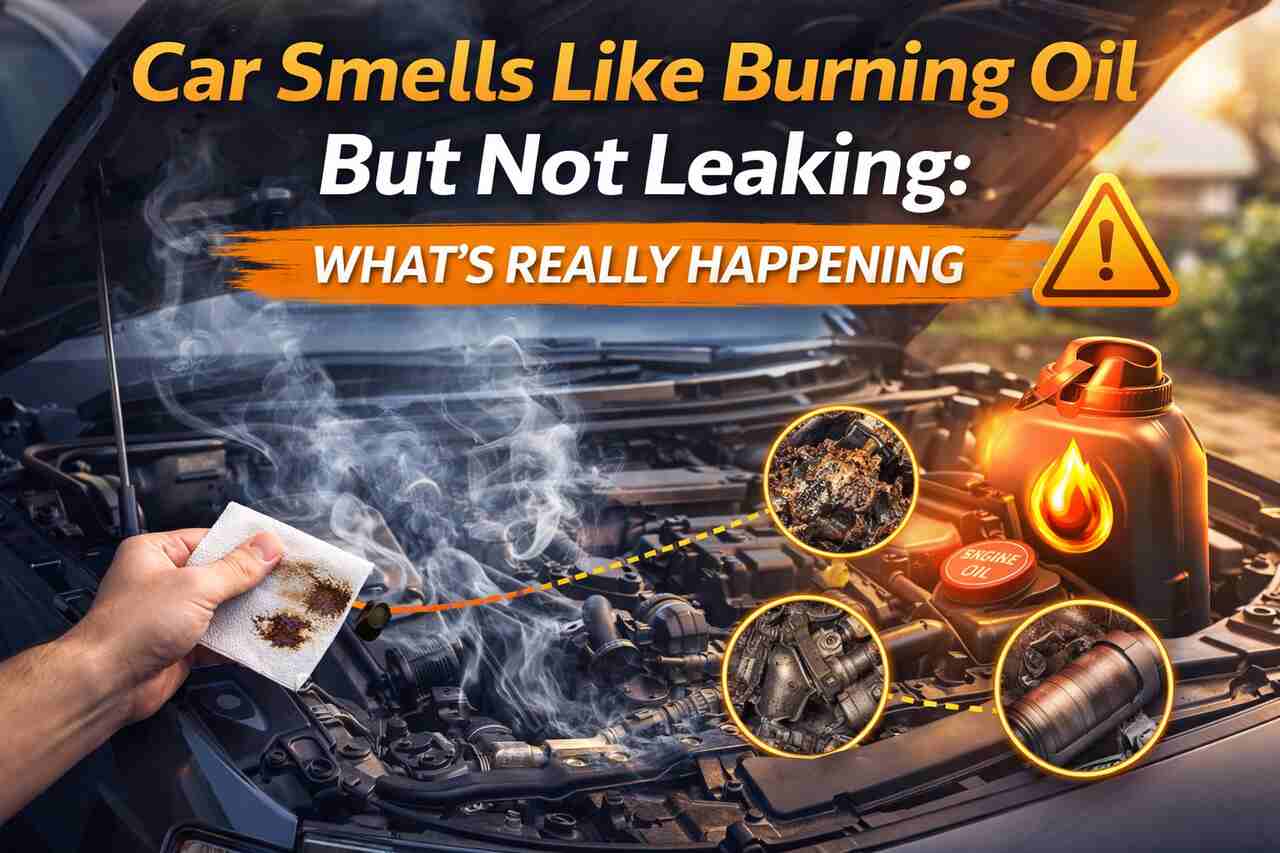

Have you ever noticed your car smell like burning oil? It’s fairly annoying and can linger, but the biggest annoyance isn’t the smell, it is the fact that something more serious could be wrong with the car.
Here’s the thing: that smell is telling you something, and ignoring it is a mistake a lot of people make. The good news is, it doesn’t always mean immediate bad news. But it DOES mean something needs attention.
Highlights:
- A burning oil smell without visible leaks usually means oil is leaking in small amounts and burning off on hot engine parts or your exhaust
- Common culprits include valve cover gasket leaks, worn seals, overfilled oil, and bad PCV valves most are fixable
- Check your oil level immediately, look for seepage around the valve cover, and monitor your engine temperature
- Don’t wait forever to get this checked oil starvation can cause serious damage if you let it go too long
Why You Smell Burning Oil (But Don’t See a Leak)
The answer here isn’t complicated, but it trips people up. Oil IS leaking. You just can’t see it because it’s burning off before it has a chance to pool up underneath your car, according to Detroit Axle, a high-quality auto parts company that has aftermarket parts available on its website.
Think about it this way: oil has a pretty low flash point. When it hits something hot your exhaust manifold, the turbo housing, or even just hot spots on the engine block it ignites. You get that distinctive smell, but zero visible evidence on the ground. Your driveway stays clean while your engine slowly loses oil.
This is actually more insidious than a big leak because you might not realize how much oil you’re losing until the damage is done.
The Usual Suspects
Valve Cover Gasket (The Most Common Culprit)
I’d say about 60% of the cars that come to me with this exact issue have a bad valve cover gasket. Back when I was at a shop in Fullerton, CA, I probably replaced these things a dozen times a month. The gasket dries out, cracks, and oil seeps onto the outside of the valve cover or nearby exhaust components.
The sneaky part? The leak is usually slow, according to this article. Not enough to leave a puddle, but enough to create that burning smell. Your oil level drops gradually, and you might not notice until you check it at an oil change .
Worn Seals and Gaskets
Beyond the valve cover, you’ve got seals all over the engine. The crankshaft seal, camshaft seals, timing cover gaskets any of these can weep oil slowly. An older engine or one with higher mileage is more prone to this. The rubber dries out, hardens, and loses its grip.
Overfilled Oil
This one catches people off guard, but it happens more than you’d think.. You add too much oil, and the crankshaft or piston rings start churning it up inside the engine, spraying droplets everywhere. Those droplets hit hot surfaces and burn. No leak, technically just too much oil doing its job badly.
Bad PCV Valve
The PCV (positive crankcase ventilation) valve controls pressure inside your engine and prevents oil vapor from building up. If it fails or gets stuck, pressure increases, and oil gets forced out past seals that normally hold tight. One of my friends called me about his 2007 Civic about three years ago with exactly this problem. Replaced the PCV, smell was gone in two days.
Worn Piston Rings
This is the more serious scenario. If your piston rings are shot, oil gets past them during combustion and burns in the cylinder. You won’t necessarily see smoke, especially if you’re only losing small amounts, but you’ll smell it. This typically shows up on higher-mileage engines.
Head Gasket Issues
A failing head gasket can let oil seep into places it shouldn’t be, where it contacts hot surfaces. This is more likely on older vehicles or ones with overheating issues in their past, especially if they have smelled like sulfur or rotten eggs before.
Electrical or Wiring Problems
Sounds weird, right? But a frayed wire or electrical short near hot engine components can scorch oil residue and create that burning smell. It’s rare, but I’ve seen it happen.
What You Should Check Right Now
Don’t just assume it’s fine and move on. Do this today:
- Check your oil level. Get a clean dipstick reading when the engine is cold. If it’s low or nearly low, that’s confirmation something is wrong. Top it up and monitor it over the next week or two. If it drops noticeably, you’ve got an active leak.
- Look for visible seepage. Pop the hood when it’s cool and inspect the valve cover, the gaskets around the timing cover, and anywhere you see rubber seals. Wipe areas clean and look for fresh oil accumulation.
- Smell the engine bay carefully. Where exactly is the smell strongest? Near the valve cover? The exhaust manifold? That narrows down your culprit.
- Watch your temperature gauge. Is the engine running hotter than usual? That might indicate internal issues like bad piston rings or cooling problems.
- Look under the car. Get under there (safely) and check the undercarriage and exhaust components for oil residue or dark, greasy buildup. That’ll tell you where the oil is burning.
When to Call a Mechanic (Don’t Put This Off)
Sure, smelling burning oil isn’t as serious as smelling burning rubber, but if that smell sticks around for more than a week or two, especially if your oil level is dropping, you need professional help. I’m not saying this to scare you or drum up business for the shop I’m saying it because oil starvation is real and it destroys engines FAST.
Once your engine runs low on oil, moving parts don’t get lubricated properly. Bearings wear out. Pistons seize. Valve train components get damaged. And then you’re looking at thousands of dollars in repairs or an engine replacement. That’s not hyperbole that’s just what happens.
A valve cover gasket replacement costs maybe $200–$500 depending on your vehicle. Letting it go until you’ve got bearing damage? That’s a $4,000+ problem.
Get it checked. Whether you’re in Orange working with a mobile mechanic or at a local shop, the diagnostic shouldn’t cost much and will give you actual answers.
What NOT to Do
Be sure to follow the following about what not to do:
- Don’t ignore it “for a while.” This isn’t something that fixes itself.
- Don’t just keep adding oil without figuring out why it’s disappearing.
- Don’t assume it’s fine because there’s no check engine light. Some issues don’t trigger codes until they’re serious.
- Don’t drive it hard or on the highway until you know what’s causing this. Stress accelerates wear.
Additional Questions You Need to Know
Is It Safe to Drive a Car That Smells Like Burning Oil But Has No Leak?
It is not safe to drive a car with a burning oil smell for extended periods. The smell indicates oil is leaving your engine somehow, and as soon as your oil level gets too low, you run the risk of serious engine damage. Short trips to a mechanic are okay, but don’t take it on highway trips or drive it aggressively until you’ve had it diagnosed.
Can Burning Oil Smell Go Away on Its Own?
No, burning oil smell will not go away on its own if there’s an actual leak causing it. Something physical is wrong a seal, gasket, or internal component failure and it needs to be fixed. Ignoring it only gives the problem time to get worse.
What’s the Difference Between Burning Oil and a Real Oil Leak?
A real oil leak leaves visible puddles or stains underneath your car. Burning oil leaks happen in small amounts where the oil ignites before dripping, so you smell it but don’t see evidence under the car. The underlying issue is the same oil is escaping just at different rates and in different places in the engine.
