


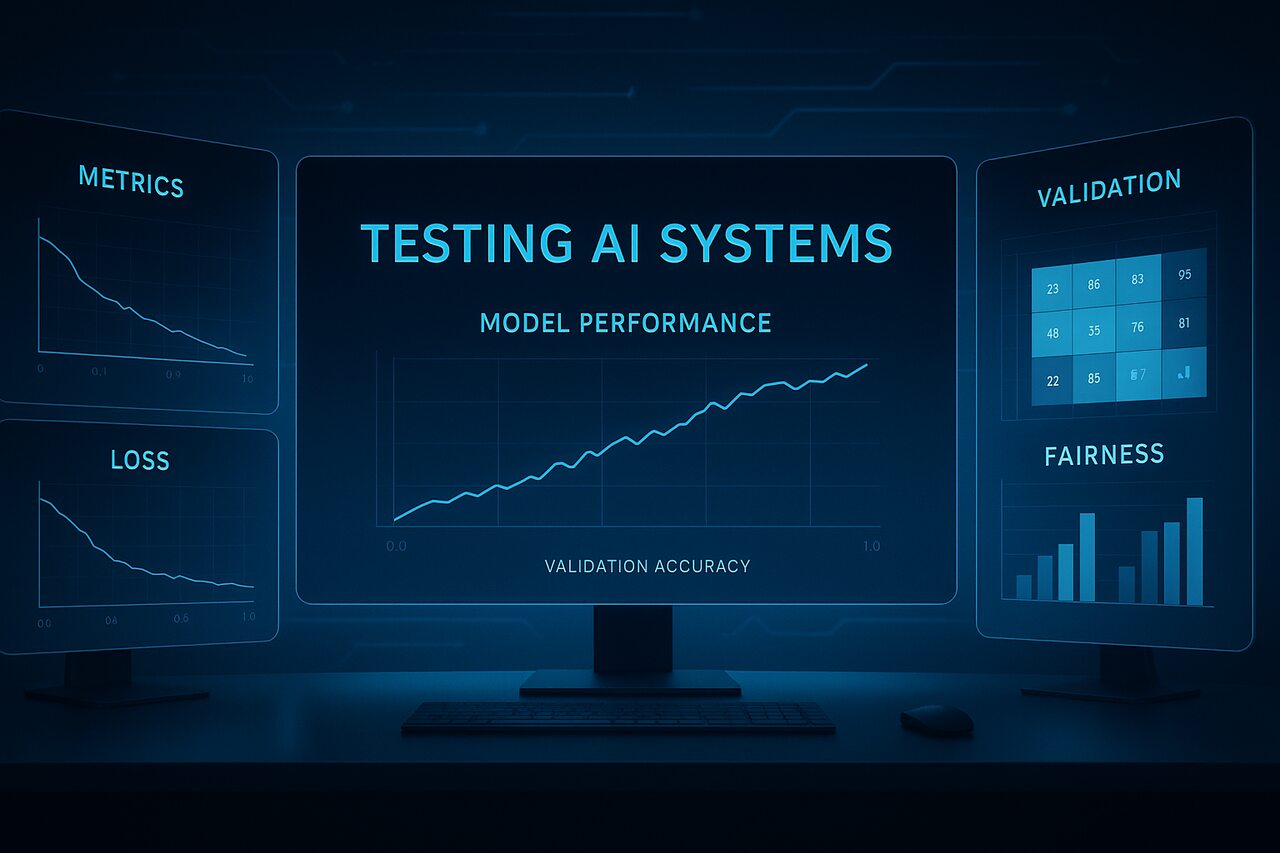


Testing AI systems means checking how models behave when things aren’t perfect, when the data is messy, incomplete, or unfamiliar. A small shift in input can throw everything off without warning. AI testing helps catch those moments, but only if you’re measuring the right things.
Accuracy alone isn’t enough. You need to understand the types of mistakes the model makes, who is affected, and how confident the system is when it’s wrong. Standard reports often miss these nuances. You need metrics that reveal what breaks, how often, and under which conditions. This isn’t about optimizing a number; it’s about seeing the model clearly, so it doesn’t catch you off guard later.
Why Standard AI Testing Isn’t Enough?
Traditional AI testing focuses on the model alone, ignoring the environment or downstream impact. A model may perform well on test data but fail once deployed. Slow input changes, shifts in user behavior, or mismatches between expected and actual data don’t trigger standard warnings. AI testing tools like LambdaTest KaneAI help fill these gaps by providing system-aware validation using natural language-based test generation.
Core Metrics for AI Testing
Core metrics help understand how a model predicts and performs. During model development and early AI testing, these include:
- Accuracy: Provides a baseline but doesn’t reveal edge cases, uncertainty, or real-world robustness.
- Precision and Recall: Balance trade-offs between false positives and false negatives. Critical for high-stakes applications.
- F1 Score: Combines precision and recall into one metric, but can hide imbalances.
- ROC Curve and AUC: Show model performance across thresholds, revealing decision boundary stability.
- Confusion Matrix: Exposes patterns in mistakes and helps uncover systematic issues.
- Log Loss: Highlights overconfidence in wrong predictions critical for AI testing of high-risk systems.
Advanced Metrics for Robust AI Testing
When standard metrics fall short, advanced metrics are essential:
- Regression Metrics (MAE, MSE, R²): Measure error size and variation explained by the model.
- Fairness and Bias: Ensure predictions are equitable across user groups.
- Calibration: Checks whether predicted confidence matches real-world outcomes.
- Robustness: Tests stability under unexpected inputs.
- Interpretability: Reveals the logic behind predictions, even when patterns are misleading.
How AI-Driven Cloud Platforms Elevate AI Testing?
AI testing is critical for ensuring that machine learning models and AI-driven applications perform reliably under real-world conditions. But managing test environments, multiple devices, and varied scenarios can quickly become overwhelming.
That’s where cloud-based platforms come in; they provide scalable, flexible infrastructure to run tests efficiently across diverse conditions without the overhead of local setups.
Cloud platforms allow teams to execute AI tests in parallel, simulate complex user environments, and capture detailed insights across multiple operating systems, devices, and network conditions. This makes testing faster, more reliable, and more comprehensive. By moving AI testing to the cloud, teams can focus on what truly matters: validating the model’s behavior and uncovering hidden edge-case issues.
One such cloud platform is LambdaTest KaneAI, which integrates AI-driven capabilities with real-world test execution, a GenAI-native testing agent within LambdaTest, simplifying AI testing by allowing teams to plan, author, and evolve tests using natural language.
With KaneAI, teams can:
- Generate intelligent tests with NLP instructions.
- Plan and automate test steps using high-level objectives.
- Export tests in multiple languages and frameworks.
- Express complex conditionals and assertions naturally.
- Test APIs alongside UI for full coverage.
- Execute tests across 3000+ browsers, OS, and device combinations.
By combining cloud scalability with AI-driven test generation and orchestration, LambdaTest and KaneAI make AI testing faster, smarter, and more reliable. Teams can run tests at scale, capture real-world insights, and ensure models behave as expected in production, all without worrying about infrastructure constraints.
Conclusion
AI testing is more than metrics. Models are part of larger systems connected to user interfaces, business logic, and human decisions. Small errors at the model level can cascade silently. Using AI testing tools like KaneAI and platforms like LambdaTest ensures validation captures not just predictions, but their real-world impact. Robust AI testing means understanding how your model performs in context, so your system holds up, even when conditions aren’t perfect.


