




Key Takeaways
- Group RRSPs are coordinated through employers and may include matching contributions, making them a potentially lucrative benefit.
- Individual RRSPs offer greater flexibility in managing investments and contribution schedules.
- Both RRSP types adhere to the same annual contribution limits set by the Canada Revenue Agency.
- Making the right choice involves considering employer programs, personal preferences, and your unique financial aspirations.
Table of Contents
- Understanding Group RRSPs
- Understanding Individual RRSPs
- Key Differences Between Group and Individual RRSPs
- Pros and Cons of Group RRSPs
- Pros and Cons of Individual RRSPs
- Making the Right Choice for Your Future
- Conclusion
Planning your retirement is one of the most impactful steps you can take for your financial future. In Canada, two of the most widely used retirement savings options are the Group Registered Retirement Savings Plan (Group RRSP) and the Individual Registered Retirement Savings Plan (Individual RRSP). Understanding the distinctions between these plans is essential in making a decision that fits your circumstances and goals. Many Canadians seek answers to the group RRSP vs individual RRSP question before committing to one approach or the other.
Both Group and Individual RRSPs are designed to help you accumulate savings in a tax-advantaged environment, giving you a head start toward a comfortable retirement. However, each plan offers distinct advantages and limitations, from contribution options to investment flexibility and employer participation. Your choice can have long-term consequences for your financial growth and peace of mind.
While Group RRSPs are typically facilitated by your workplace, offering the convenience of payroll deductions and possible employer matching, Individual RRSPs allow you to assume full control over your investment decisions and savings schedule. The investment options, tax deductions, and accessibility differ between the two, so carefully weighing these factors is critical to maximizing your benefits.
Whether you are early in your career or approaching retirement, understanding the nuances of each RRSP type will help ensure your contributions align perfectly with your overall retirement strategy. Make sure to review all features of each plan before deciding which path to take. For a broader look at personal finance and retirement planning in Canada, visit the Government of Canada’s retirement planning page.
Understanding Group RRSPs
A Group RRSP is an employer-sponsored plan that allows employees to contribute a portion of their income into a registered retirement savings account directly through payroll deductions. The immediate advantage is simple: your contributions are made before your income is taxed, instantly lowering your taxable income. Some employers also provide matching contributions, boosting your savings at no extra cost to you. However, investment options are determined by the plan’s sponsor, which means the range of available mutual funds or securities may be limited compared to other types of accounts.
Understanding Individual RRSPs
An Individual RRSP is a personal retirement account you open through a bank, credit union, or investment firm, independent of your employer. You have complete flexibility over your choice of investments, from stocks and bonds to ETFs and GICs, allowing you to tailor your portfolio based on your financial goals and risk tolerance. Contributions can be made at your own pace, with the option to deposit lump sums or set up automatic transfers. Your tax deduction is claimed when you file your annual tax return, offering flexibility for tax planning. However, it takes personal discipline to regularly maximize contributions.


Key Differences Between Group and Individual RRSPs
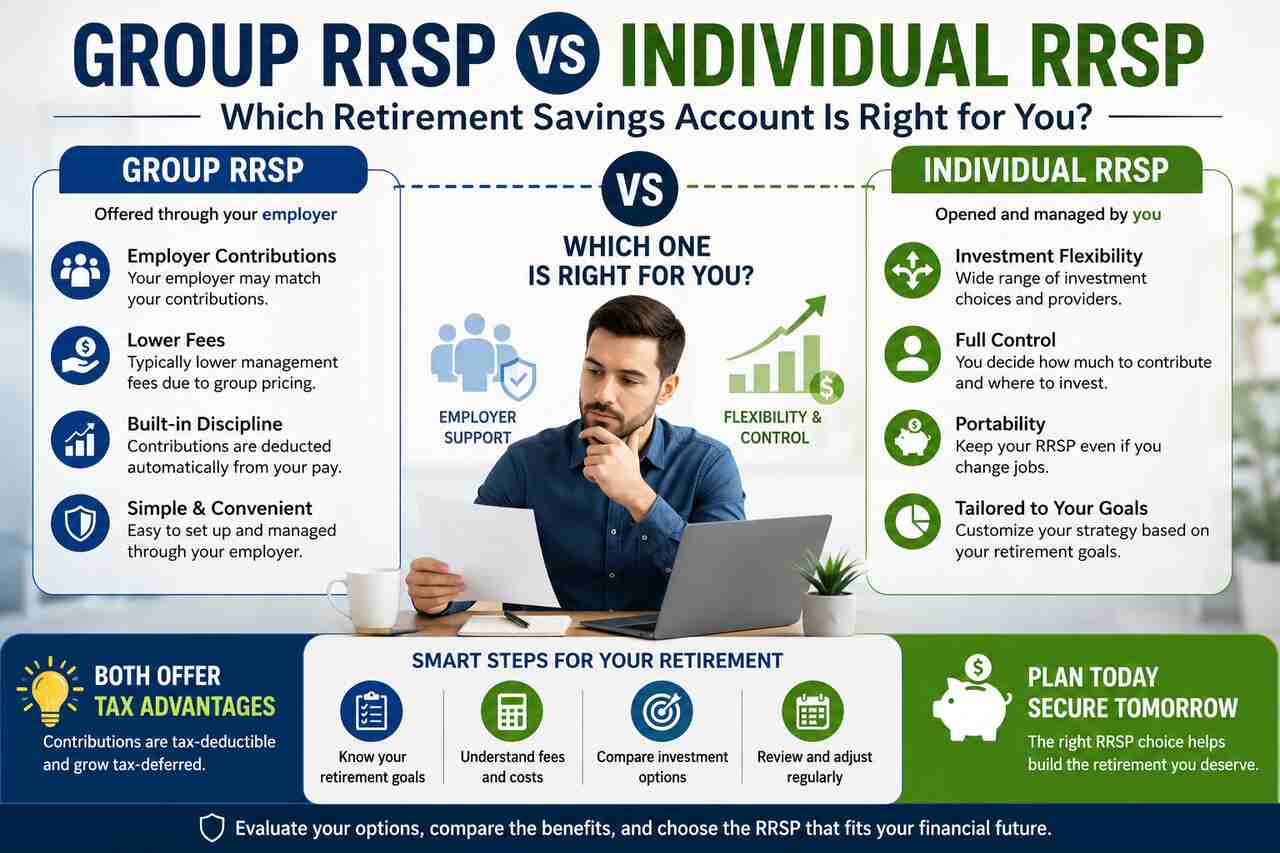
A Group RRSP is employer-sponsored, while an Individual RRSP is individually established. Contributions to a Group RRSP are made through payroll deductions, with possible employer matching, whereas an Individual RRSP offers flexible, self-directed contributions with no employer matching. Both provide tax benefits: a Group RRSP offers an immediate tax reduction, and an Individual RRSP provides a tax deduction at filing. The employer plan usually limits investment options in a Group RRSP, while an Individual RRSP offers extensive diversity and choice. Fees for a Group RRSP are typically lower due to group rates, whereas fees for an Individual RRSP are market-dependent and potentially higher.
Pros and Cons of Group RRSPs
Pros:
- Employer Matching: Potential for significant additional retirement savings through matching contributions.
- Immediate Tax Advantage: Contributions are deducted from your taxable income right away.
- Lower Management Fees: Group rates often mean you pay less in account fees or MERs.
Cons:
- Restricted Investment Choices: The employer chooses the available funds or investment vehicles.
- Less Flexibility: Limited control over both investments and possibly access if you leave the employer.
Pros and Cons of Individual RRSPs
Pros:
- Full Investment Control: Select and adjust your investment strategy according to your own objectives.
- Flexible Contributions: Make lump-sum deposits or frequent small contributions as it suits you.
Cons:
- No Employer Match: All contributions come from your own resources, without matching from employers.
- Potential for Higher Fees: Depending on the institution and products you choose.
Making the Right Choice for Your Future
Selecting between a Group RRSP and an Individual RRSP requires you to evaluate what matters most for your situation. If employer matching is available, it is often wise to take full advantage of the additional savings, as this can dramatically accelerate your retirement growth. If investment autonomy and flexibility are important to you, or your employer does not offer a Group RRSP, an Individual RRSP may be preferable.
Be aware that your total RRSP contribution room covers all RRSP accounts registered in your name. Exceeding the annual contribution limit can result in tax penalties, so be diligent in tracking your deposits. Consider consulting with a financial advisor or exploring resources at MoneySense for robust discussions on retirement strategies.
Conclusion
Both Group and Individual RRSPs provide effective tools to build your nest egg with tax benefits. Your decision should reflect both your current employment benefits and your larger financial vision, including desired investment options, savings habits, and retirement goals. Evaluate each plan according to its merits, and wherever possible, harness employer contributions to their full potential. Ultimately, carefully planned and consistently funded RRSPs can give you confidence and security as you approach retirement.


