





Key Takeaways
- Clinical trial design ensures new treatments are tested safely and effectively before reaching patients.
- A clear research question, using the PICO framework, guides the entire study.
- The study protocol defines how the trial is conducted, including participant selection, procedures, and data analysis.
- Clinical trials follow four main phases, from early safety testing to long-term real-world monitoring.
- Ethical oversight, including IRB review and informed consent, protects participant rights and safety.
- Challenges include recruitment, cost, and minimizing bias while maintaining scientific rigor.
- Innovations such as adaptive and continuous trial designs are improving efficiency and accelerating research.
- Overall, a strong trial design is essential for producing reliable medical evidence and advancing healthcare.
Introduction to Clinical Trial Design
Clinical trials play a fundamental role in advancing medicine and improving patient outcomes. These research studies are carefully structured to test new therapies, medications, or devices, confirming their safety and efficacy before they reach wider populations. Understanding the steps in a clinical trial is essential for both participants and researchers, as these steps provide the foundation for valid and trustworthy results. Meticulous planning at each phase ensures that findings contribute valuable evidence to the medical field and enhance future healthcare.
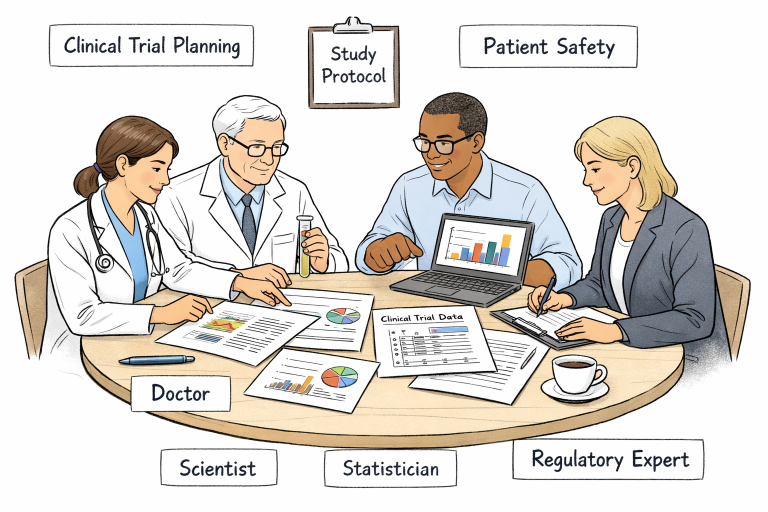
Designing a clinical trial is much more than a simple experiment. It requires coordination among clinicians, statisticians, and regulatory experts to answer important health questions. Each aspect, from the earliest brainstorming sessions to the interpretation of the final results, serves a specific purpose to protect patient safety and ensure rigor. This process ultimately lays the foundation for modern medicine by enabling new innovations to be brought forward carefully and ethically.
Defining the Research Question
The journey of a clinical trial begins with a precisely crafted research question. Researchers utilize the PICO framework (Population, Intervention, Comparison, Outcome) to ensure that their question is specific, measurable, and relevant. This initial step is crucial because a well-formulated question directs every choice made throughout the trial’s lifecycle, from selecting eligible participants to defining primary outcomes for evaluation. Thoughtful development of the research question serves as the guiding compass for the study’s success and impact.
Whether the goal is to study a new drug’s ability to improve survival rates or compare surgical techniques, clarity in the research objective allows the study to proceed with purpose and structure. This clarity also helps minimize bias and ensures that subsequent findings are robust and meaningful.
Developing the Study Protocol
After the research question is finalized, attention turns to crafting a comprehensive study protocol. This foundational document outlines every detail of the proposed trial: how participants are selected, how interventions are administered, and how data is collected and managed. Protocols are designed to minimize inconsistencies and ensure that the study can be replicated or reviewed independently.
Detailed protocols also describe procedures for data analysis so that pre-specified outcomes are not influenced by interim findings or subjective interpretation. In practice, the protocol guides all team members, ensuring a standardized approach and allowing external stakeholders, such as regulatory agencies, to assess the study’s validity before the trial begins.

Phases of Clinical Trials
Clinical trials typically progress through a series of defined phases, each with distinct goals and methodologies:
- Phase I: Early studies focus on safety, appropriate dosage, and side effects, usually with a small group of healthy volunteers or patients.
- Phase II: Once safety is established, researchers evaluate short-term side effects and preliminary efficacy in a larger patient group. This phase helps determine optimal dosages and refines the study’s protocols.
- Phase III: Larger-scale studies confirm effectiveness, monitor for rare side effects, and compare new interventions with current standards of care. The results provide the clearest evidence of benefit-to-risk and often serve as the foundation for regulatory approval.
- Phase IV: Post-marketing trials track outcomes in diverse populations after the intervention becomes available to the public, gathering information on long-term safety or rare effects.
Ethical and Regulatory Considerations
Rigorous ethical standards protect participants and uphold the integrity of clinical research. Every clinical trial requires review and approval by an Institutional Review Board (IRB), which ensures that risks are minimized and that participants’ rights are safeguarded. Informed consent is another cornerstone: participants are provided with thorough information about the study, its risks, and potential benefits before volunteering. Global and national regulations, such as those set forth by the Food and Drug Administration, require compliance with best practices and transparent reporting.
Challenges in Clinical Trial Design
Clinical trial design poses many challenges. Recruiting a diverse and adequate participant population can be difficult, especially for rare diseases or hard-to-reach demographics. Adhering to strict protocols is essential, yet it can also lead to high operational costs and logistical obstacles. Furthermore, minimizing experimental bias and ensuring the broad applicability of results requires careful planning and methodological rigor. Researchers continually work to balance the need for scientific thoroughness with the need for efficient progress in the face of these hurdles.
Innovations in Clinical Trial Design
The landscape of clinical trials is evolving with the introduction of innovative designs aimed at improving both efficiency and the relevance of outcomes. Adaptive trial designs, for example, enable researchers to modify aspects of the study in response to early results without undermining statistical integrity. This can include altering patient allocation, re-estimating sample sizes, or adjusting endpoints, all with the goal of accelerating the trial process and better utilizing resources.
Emerging approaches, such as continuous clinical trials, go a step further. By minimizing downtime between trial phases and making real-time adjustments based on accumulating evidence, these novel models help researchers move promising therapies forward more quickly.
Final Thoughts
Designing clinical trials is a highly structured yet continually evolving process that underpins the progress of modern medicine. Each step, from identifying a pivotal research question to navigating a study through rigorous regulatory and ethical oversight, is critical for producing meaningful clinical evidence. As researchers continue to innovate, the hope is that trials will become even more efficient, inclusive, and impactful, ultimately leading to faster discovery and broader access to life-changing treatments.


