





Software development is entering a very different phase compared to just a few years ago. What once required coordinated work between frontend developers, backend engineers, and infrastructure teams can now often be achieved through AI-assisted platforms.
One of the most noticeable changes is the growing influence of no-code platforms. These tools are no longer experimental or limited to small projects. They are becoming part of the mainstream product development process.
What makes this shift significant is not just technology, but access. Development workflows that were once technical are now becoming more visual and guided by AI. This change allows people outside traditional engineering roles to participate in building software.
Entrepreneurs, educators, and independent creators can now create applications that serve real users. This represents a structural change in how digital products are developed.
The evolution has been rapid. Early no-code tools mainly supported landing pages or demonstrations. Current platforms now support authentication systems, complex logic, payment infrastructure, and scalable architecture. They are no longer limited tools. They are viable development environments.
Why Applications Remain Strategically Important
Even with strong mobile websites, many businesses still question whether they need dedicated apps. However, usage patterns suggest the importance of applications continues to grow.
User expectations have changed. Applications are often preferred because they provide faster access and more personalized experiences. Instead of navigating multiple pages, users interact with a single environment.
From a strategic perspective, apps also help strengthen brand presence. When a product becomes part of a user’s daily digital routine, it increases familiarity and trust. Websites alone rarely create the same level of continuity.
Market behavior also reflects this trend. Mobile apps often demonstrate stronger engagement metrics and higher conversion performance compared to mobile websites. Users tend to spend more time and complete more actions within app environments.
By 2026, having a website is simply part of basic digital presence. Having a well-designed application increasingly defines competitive differentiation.
Why No-code Platforms Are Becoming Core Infrastructure
Once an organization decides to build software, the next decision is how to execute it. Traditional development remains effective, but it often involves significant investment in time, cost, and coordination.
No-code platforms introduce a different model. They focus on reducing development friction while maintaining practical functionality.
The main advantage lies in operational efficiency. AI builders can now deliver many of the same capabilities as traditional development approaches while reducing complexity and timelines.
Because development is always constrained by resources, platforms that reduce both cost and time naturally become more important. This explains why no-code tools are shifting from optional solutions to core infrastructure in modern product development.
How MeDo fits into the current no-code landscape
Among the growing number of no-code platforms, MeDo has positioned itself around a simple principle: generating complete applications instead of isolated components.
Rather than focusing only on interface creation, the platform generates working systems that include frontend structure, backend processes, and data logic.
Unlike AI coding tools that still assume programming knowledge, MeDo is designed for users without technical backgrounds. And unlike platforms focused on visual prototypes, it aims to produce usable products from the beginning.
Its approach reflects a broader trend: reducing technical barriers while increasing product readiness.
How the platform workflow reflects new development patterns
The workflow begins with natural language input. Users describe what they want to build or provide visual references.
Instead of requiring technical architecture decisions upfront, the system generates the interface, logic, and data structure together. This reduces fragmentation and creates a more cohesive product from the start.
Another notable feature is iterative refinement. Instead of rebuilding projects from scratch, users can modify features gradually. This mirrors how real products evolve through continuous improvement.
The final result is not just a prototype but a live product that can be accessed, tested, and improved over time.
Key Factors That Differentiate MeDo
Complete System Generation
Many no-code tools still divide development into separate steps. MeDo instead builds frontend, backend, and database layers simultaneously. This reduces integration complexity.
Because infrastructure is included, users do not need to configure hosting or external systems before testing their product.
This significantly shortens the path from idea to working software.

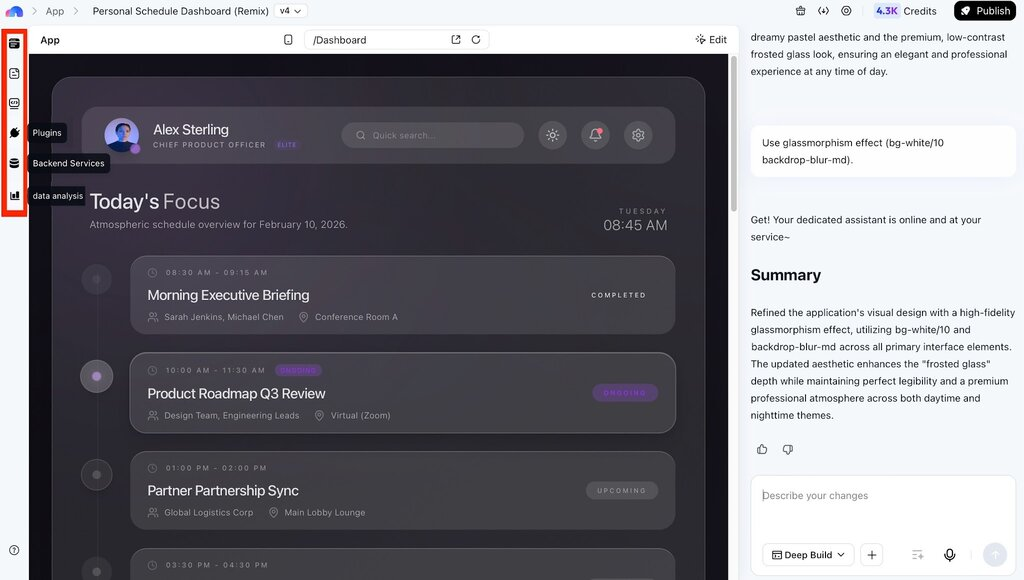
Accessibility for Non-technical Users
Technical terminology often remains a barrier in no-code platforms. MeDo attempts to reduce this friction by focusing on idea-driven workflows rather than technical configuration.
When issues appear, the system often resolves them automatically. This removes the need for manual debugging.
The ability to convert screenshots into editable layouts also reflects a shift toward visual development processes.
Integration Readiness
Applications must support real usage scenarios. MeDo’s plugin environment allows integration of payments, media tools, and AI features.
This allows projects to move beyond demonstration use and into operational deployment.
Designed for Production Use
Many tools perform well during early testing but struggle under real usage conditions. MeDo is designed to support applications intended for real deployment.
Use cases include SaaS platforms, internal tools, interactive applications, and mobile products.
With more than one million applications created on the platform, its adoption suggests practical usability rather than theoretical capability.
A Usage-based Pricing Structure
Subscription pricing can discourage experimentation. MeDo instead uses a credit model that allows users to build without committing to recurring costs.
Daily credits allow testing without financial pressure. Paid plans beginning at $20 offer a gradual path toward scaling.
This reflects a broader trend toward flexible usage-based pricing in developer tools.
Breadth of Use Cases
Applications built with MeDo span multiple categories, including SaaS platforms, business tools, games, internal systems, e-commerce solutions, and education platforms.
Each includes backend infrastructure and user management, reinforcing the platform’s focus on complete product delivery rather than concept validation.
Final Perspective
As the no-code space continues to mature, the difference between platforms increasingly comes down to outcomes rather than promises. Many tools simplify the first steps of development but still leave technical gaps later.
MeDo’s approach reflects a different philosophy. By reducing technical barriers across the full development lifecycle, it allows users to focus on product value rather than infrastructure.
For individuals and organizations seeking practical alternatives to traditional development complexity, this kind of approach is becoming increasingly relevant.
For builders focused on speed, accessibility, and real product outcomes, platforms built around complete workflows are likely to define the next stage of software development.


